
05 • 08 • 2026
Stop the Misuse of Emergency Shoreline Permits at Mantokuji Mission
VICTORY: Mantokuji BLNR Decision Establishes Guardrails Around Emergency Shoreline Permitting
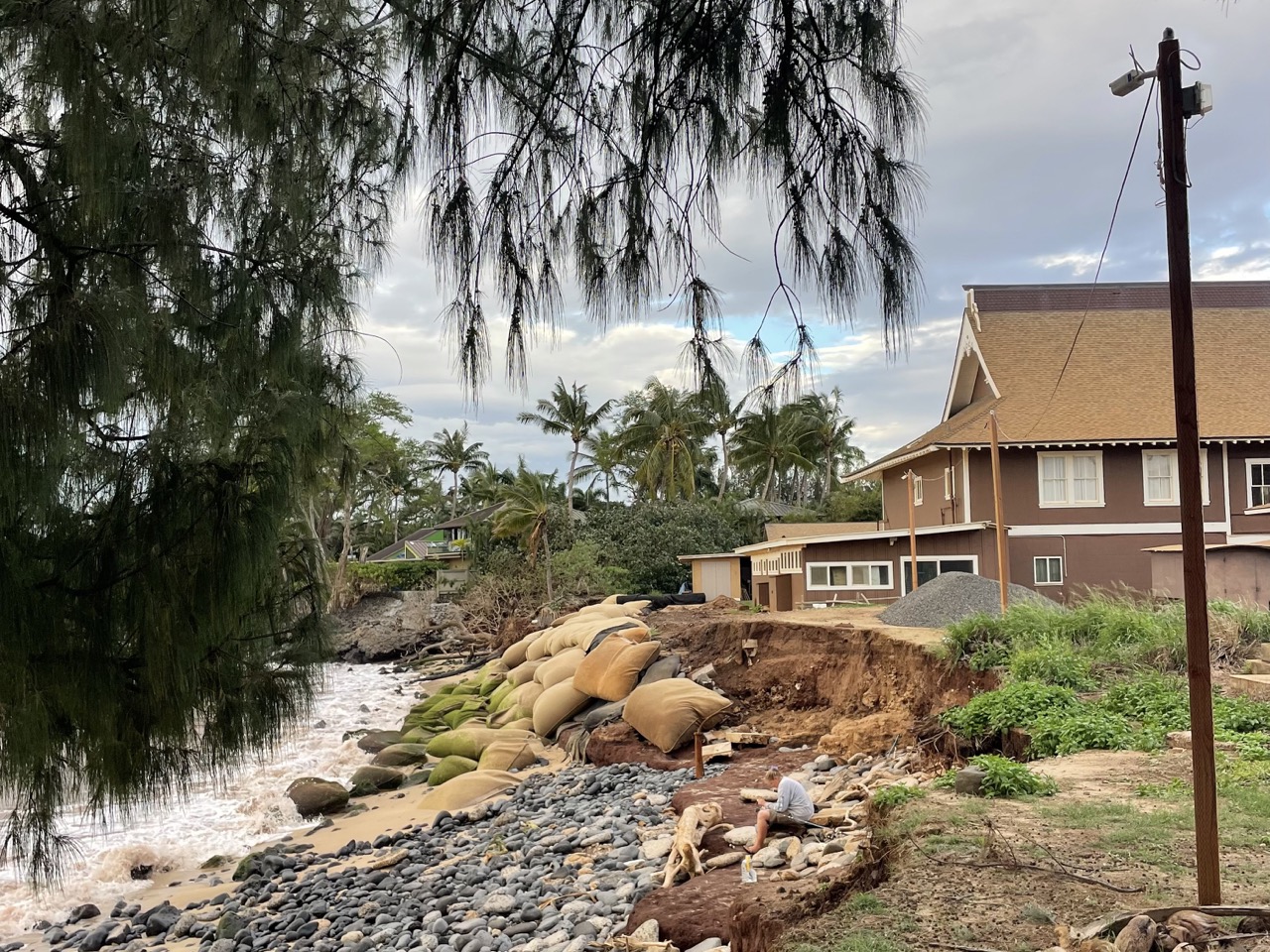
The Pāʻia Mantokuji Soto Zen Mission is a deeply important cultural and historic place on Maui’s north shore, tied to generations of family memories, community gatherings, and shoreline ancestry. But Mantokuji also reflects one of the hardest realities of climate adaptation in Hawaiʻi: some of the places communities care about most are located along increasingly vulnerable shorelines facing chronic erosion and sea level rise.
In 2021, Mantokuji Mission and their engineering consultants with Oceanit obtained an Emergency Conservation District Use Permit (ECDUP-MA 21-10) from the State of Hawaiʻi to address immediate shoreline erosion threatening the temple and associated structures. The emergency authorization was intended as a temporary measure designed to buy time for realistic long-term adaptation planning.
Importantly, the original permit conditioned relocation and direct adaptation of the threatened structure as the intended long-term pathway.
However, over the following years, the process increasingly shifted away from realistic adaptation planning and toward speculative shoreline intervention concepts including offshore nourishment and hybrid reef breakwaters. A 2023 Oceanit report itself acknowledged that relocation was not being prioritized while long-term implementation pathways for the proposed engineering concepts remained unclear.
By 2026, rather than advancing a realistic and implementable long-term solution, the applicant returned seeking another emergency permit extension while presenting increasingly conceptual regional shoreline engineering proposals that still lacked clear implementation pathways, identified funding sources, and extensive future permitting requirements. The conceptual plans put before the Board included a hybrid offshore breakwater and large-scale beach nourishment proposals with broader regional shoreline implications. No single parcel or engineering consultant should dictate the future of regional-scale shoreline intervention strategies.
At the same time, Oceanit and the Mission supported legislative efforts that would have exempted certain shoreline intervention activities from portions of Hawaiʻi’s permitting and environmental review framework — proposals that were ultimately rejected by the State Legislature.
The Problem With Emergency Shoreline Permits
Emergency Conservation District Use Permits (ECDUPs) are intended as short-term emergency authorizations for immediate threats to public health, safety, and welfare. Historically, these permits have often been approved administratively without public process or environmental review. Across Hawaiʻi — and especially on Maui — emergency shoreline permits have increasingly drifted far beyond their original intent through repeated extensions and incremental shoreline hardening measures that remain in place for years.
More broadly, a key goal of Surfrider Hawaiʻi is to bring more public scrutiny, environmental review, and Board oversight to the emergency permit process.
A Precedent-Setting BLNR Hearing
On May 8, 2026, the Board of Land and Natural Resources (BLNR) held a historic hearing on Mantokuji’s request to extend its emergency permit for an additional three years. Importantly, this marked the first known instance of an ECDUP renewal being brought before the Board itself rather than handled administratively behind closed doors.
The hearing subjected the emergency permitting process to broader public scrutiny and raised larger statewide questions regarding how Hawaiʻi handles prolonged shoreline emergencies and repeated emergency permit extensions moving forward.
Surfrider Foundation, along with local environmental activists, testified that emergency permits should not become long-term pathways for speculative shoreline engineering concepts absent meaningful public process, environmental review, independent scientific scrutiny, and realistic long-term adaptation planning. Link to Maui Now Article.
Read our testimony here.
Our concerns centered on the project increasingly drifting away from the original intent and conditions of the 2021 emergency permit, while repeated emergency permit extensions with limited progress toward viable long-term implementation strategies risk transforming an emergency authorization process into a long-term shoreline planning mechanism for chronic erosion.
Surfrider urged the Board to require any future long-term shoreline protection proposals to proceed through a full Conservation District Use Permit process with environmental review and opportunity for public comment.
Many of these same concerns were echoed throughout the Board discussion itself. Board members and OCCL staff repeatedly questioned the lack of meaningful progress toward an implementable long-term solution after more than four years of emergency permitting extensions, the speculative nature of proposed offshore nourishment and breakwater concepts, and the years of permitting, environmental review, and baseline studies that would still be required before implementation could even begin.
BLNR ultimately denied the requested three-year extension and instead approved only a one-year extension while directing the applicant toward a formal Conservation District Use Permit process for any future long-term shoreline protection proposals.
That decision was significant not simply because of Mantokuji itself, but because it reintroduced public oversight, environmental review, and Board-level accountability into a shoreline emergency permitting process that has increasingly drifted beyond its original purpose.
As Hawaiʻi faces accelerating shoreline erosion and sea level rise statewide, the Mantokuji decision signals an important shift toward greater transparency, consistency, and public scrutiny in how long-term shoreline adaptation decisions are made moving forward.
For a deeper dive into the broader policy implications, shoreline adaptation tensions, and governance concerns surrounding the Mantokuji case, read our full blog here.