The Surfrider Foundation and our coastal protection partners are lending legal and scientific support in court for North Carolina towns to protect public health, safety and welfare from collapsing coastal houses and at-risk public roads.
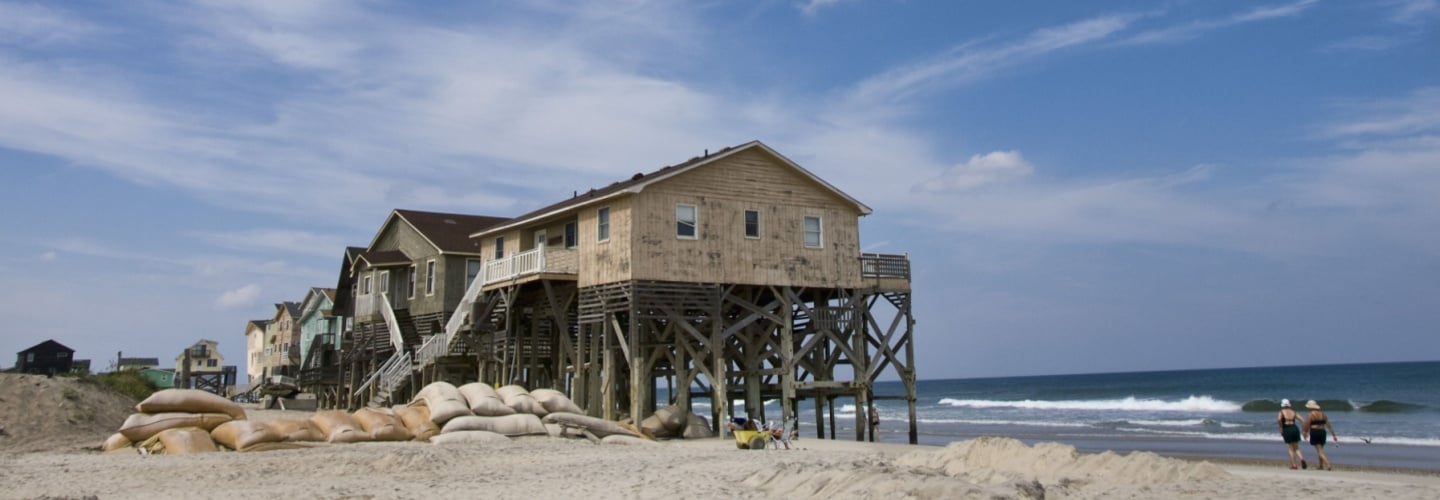
Yesterday, Surfrider, on behalf of its Outer Banks Chapter, and represented by the Southern Environmental Law Center and the Duke Environmental Law and Policy Clinic, submitted a motion for leave to file an amicus curiae (“friend of the court”) brief to the North Carolina Court of Appeals, along with the brief, defending the Town of Nags Head’s decision to condemn and remove an oceanfront house that had been encroaching on the beach and at risk of collapse due to chronic erosion and sea level rise. The house had fallen into significant disrepair, violating town building rules, and posed a hazard to public health and safety. The Town also closed the oceanfront road in front of the house, after it had become chronically inundated with beach sand from erosion. The property owner sued the Town, and the Town won at the lower court.
Surfrider’s request to file the brief tells the Court of Appeals about Surfrider members’ many recreational and stewardship uses of the beach – from birding, surfing, swimming, and beach walking, to the beach cleanups Surfrider members conduct along the State’s coast. It tells the Court how these longstanding public uses on the State’s beaches are harmed by encroaching, imperiled houses and infrastructure, whether by the encroachments taking up physical beach space that the public could otherwise use and enjoy, or by the dangerous debris such at-risk structures scatter when they collapse under nature’s forces. Surfrider members are concerned about their safety at the beach after storms cause such collapse, for fear of dangerous debris in the sand and waves. Safeguarding towns like Nags Head’s authority to abate such nuisances, in order to protect public health, safety, and welfare, along with the welfare of North Carolina’s beaches, is critical to protect the state’s irreplaceable natural coastal resources along with the State’s tourism economy that depends upon them.
The filings describe the consequences that would plague towns like Nags Head if they were required to maintain coastal roads subject to chronic erosion and sea level rise. For example, it is taxpayers who foot the bill for costly dredge and fill projects that put new sand on the beach, and those projects must be done over and over again to replace sand that will merely wash away over time, and which would only continue to cover such coastal roads. Further, dredge and fill can negatively impact nearshore fish habitat and even surf breaks. Without the ability to appropriately close coastal roads under the police powers to protect health, safety, and welfare, North Carolina towns would be precluded from taking more appropriate coastal protection responses, like moving coastal infrastructure inland, that are needed to have healthy, dynamic coasts.
Surfrider was pleased to be joined on the brief by North Carolina Land of Water, renowned coastal geologists Dr. Robert Young and Dr. Stanley Riggs, and grateful to the Southern Environmental Law Center and Duke Environmental Law and Policy Clinic for their generous representation.

 Staley Prom is an in-house attorney, providing legal guidance to the organization and its chapters across the U.S. She holds a J.D. from UCLA School of Law, and graduated summa cum laude from the University of Florida with degrees in business administration and communications.