
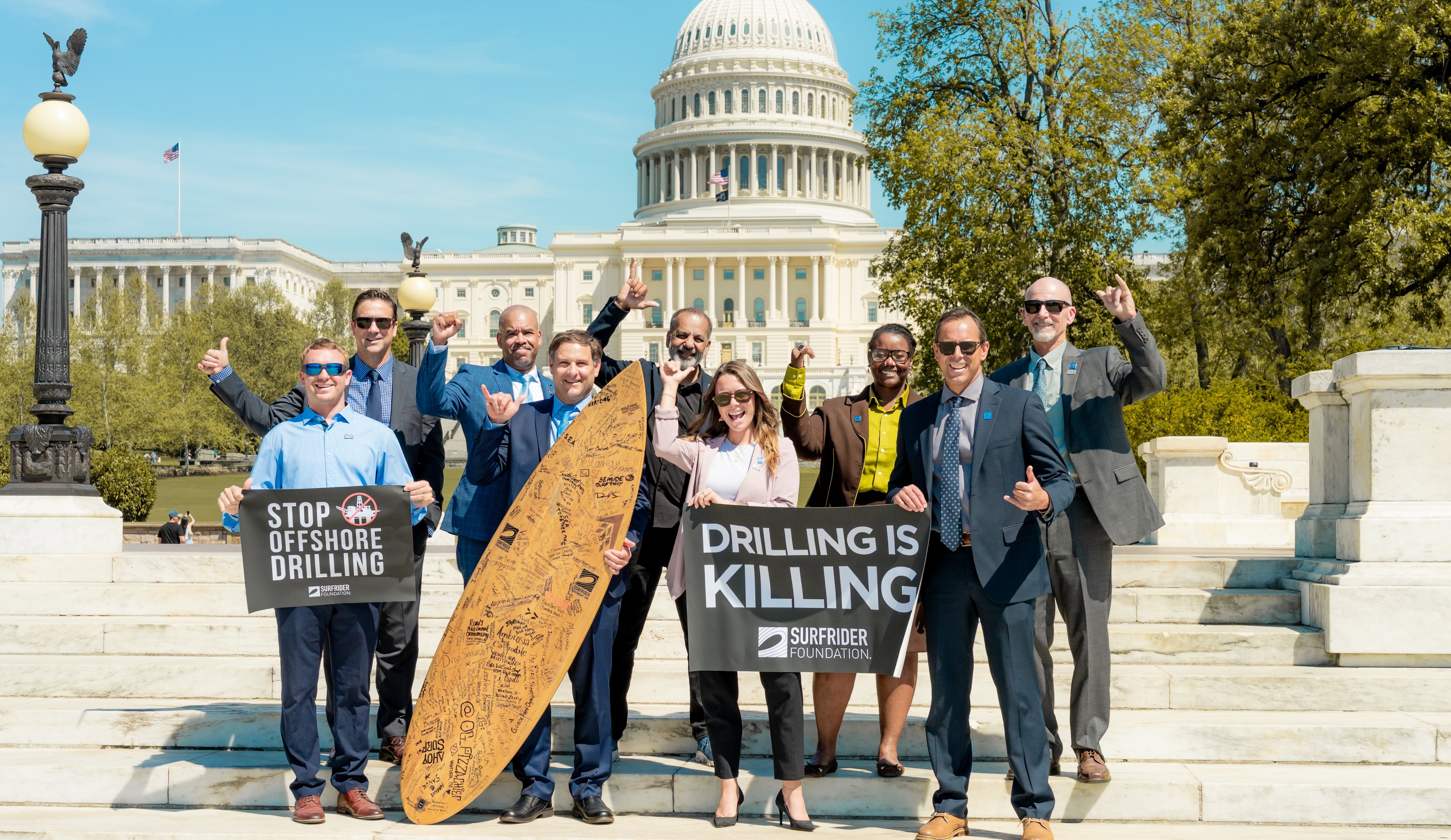
Surfrider and a cohort of ocean industry leaders traveled to Washington, D.C. to urge the U.S. Department of the Interior and Congress to protect U.S. coasts from new offshore drilling.
The group of coastal industry and community leaders that assembled in our nation’s capital last week was both powerful and diverse. A surf industry executive from Huntington Beach, a former oil and gas worker from Texas, an aquarium CEO from Tampa, FL, a coastal ecologist from Louisiana, a chamber of commerce president from the Florida Keys, and a sportfishing and whale watching operator from Dana Point, CA were among those that traveled to Washington D.C. to urge our federal leaders to cancel plans for new offshore oil drilling off U.S. coasts.
On April 16-17, the Surfrider Foundation and a delegation of industry leaders met with officials from the U.S. Department of the Interior, Bureau of Ocean Energy Management (BOEM), and members of Congress to express unified opposition to the federal government’s plans to expand offshore oil and gas drilling in U.S. waters. Representing our nation’s surfing, fishing, and coastal tourism industries, as well as environmental and community concerns, participants braved a record-setting spring heat wave to bring a unified message to D.C.: more offshore oil drilling threatens ocean ecosystems, our nation’s economy, and a way of life enjoyed by millions of people.
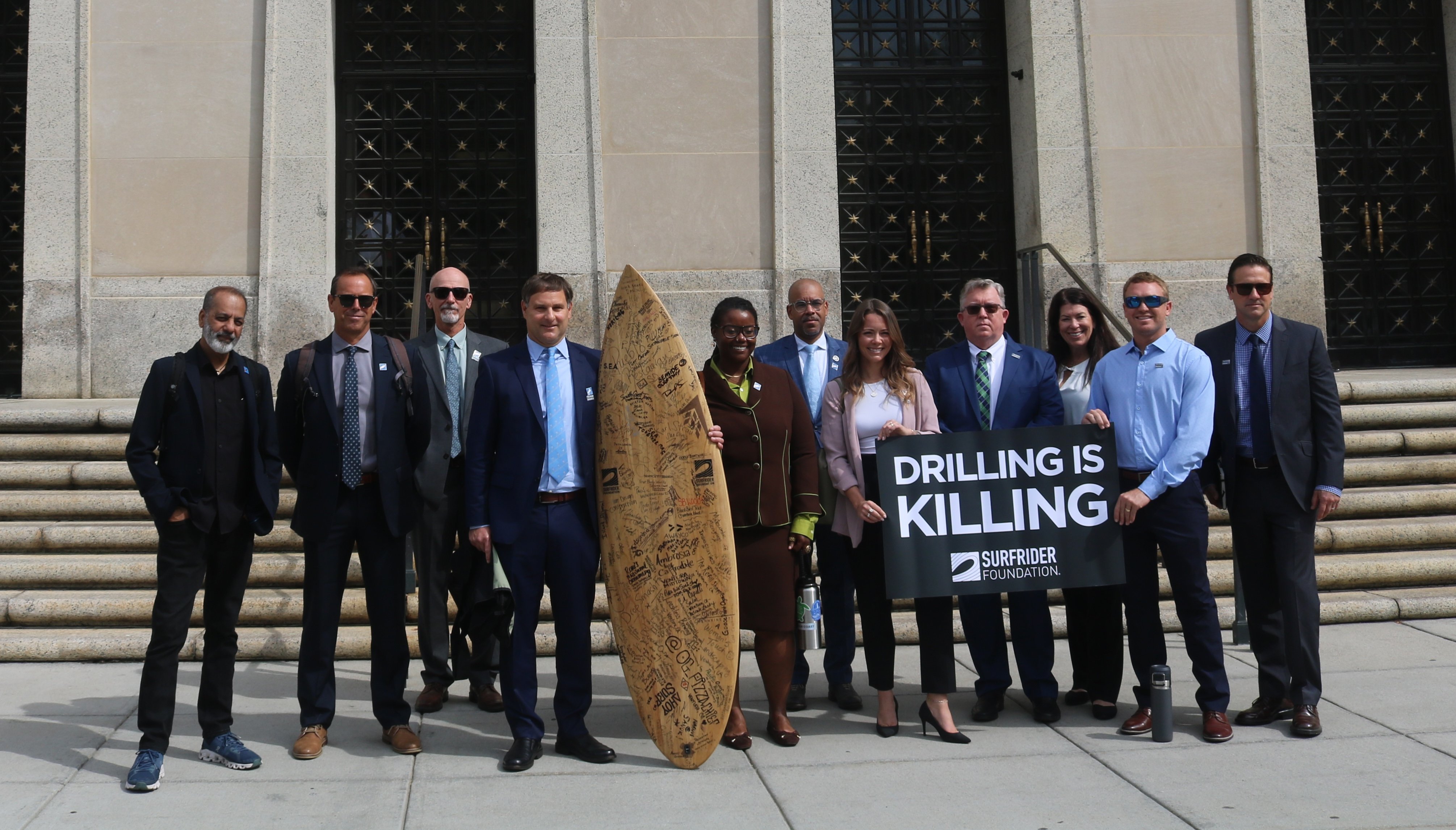
Surfrider's delegation at the U.S. Department of the Interior. Photo: Trey Highton
During the meeting with the BOEM Directorate, Surfrider’s delegation presented agency officials with a signed surfboard and letter representing over 50,000 coastal businesses that are opposed to new offshore oil drilling. The surfboard — one of several visiting communities across the nation — symbolizes how coastal economies depend on healthy marine ecosystems. Across the U.S., businesses, including restaurants, retailers, surf shops, hotels, and seafood businesses are signing the surfboard and joining regional business alliances on the Pacific, Atlantic, and Florida Gulf coasts to oppose new offshore oil and gas development.
The meeting with administration officials at BOEM was substantive and respectful, but the ultimate outcome remains unclear. Agency leaders stressed that the federal offshore drilling plan is still a draft and that the process is designed to narrow down geographic areas for potential development. The agency also emphasized the importance of public feedback in their decision-making process and noted plans to open another comment period after the release of the Proposed Program - i.e., the second draft of the offshore drilling plan, which is expected to be released soon.
Nevertheless, the current draft offshore drilling plan is alarming in both scope and scale. The proposal targets over 1.2 billion acres of U.S. ocean for new oil and gas leasing over the next 5 years, including the federal waters off California, the Gulf of Mexico, Alaska, and the Arctic Ocean — including areas of the High Arctic that have never been drilled before because of the extreme environmental hazards. The proposal is part of a broader undertaking by the administration to sell our public lands and waters to the oil and gas industry under the mantra of “Drill, Baby, Drill!” In the coming weeks, BOEM will release the Proposed Program, which will reveal what consideration the administration has given to the 300,000 + comments submitted against the proposal this past winter.

Beach visitation is a major economic driver of the U.S. economy, but is threatened by new offshore drilling.
To help stop the administration’s plans for new offshore drilling, Surfrider and our partners are urging members of Congress to voice their opposition. This strategy is bearing dividends, particularly in Florida, where every member of Congress has signed a bipartisan letter opposing the offshore drilling plan. Surfrider is also championing legislation to prohibit new offshore drilling as one of our priorities for the 2026 Coastal Recreation Hill Day. During our 10th annual Hill Day on April 28-29, Surfrider members will meet virtually with over 100 House and Senate offices to urge Congressional action on this and other priorities.
Take Action: Tell Congress to pass legislation to prohibit new offshore drilling!
Make Your Voice Heard!
1) Contact your members of Congress: Your federal representatives need to hear from you! Complete the action alert to urge your Senate and House members to oppose the federal administration’s plans and pass legislation to protect all U.S. coasts from new offshore drilling.
2) Participate in BOEM’s upcoming comment period: In the coming weeks, the agency is expected to release the Proposed Program and open a final 90-day public comment period. Follow and subscribe to Surfrider’s channels for the latest news and opportunities to take action.
3) Get involved with your local Surfrider chapter. Across the country, Surfrider chapters and student clubs are building grassroots opposition to new offshore drilling through community education, advocacy, and coalition building. Click here to find your local chapter or club.
Quotes from Surfrider’s Delegation
“The Surfrider Foundation is strongly opposed to the Trump administration's plans to expand offshore oil and gas drilling in U.S. waters”, said Dr. Chad Nelsen, CEO of the Surfrider Foundation. “New offshore drilling will damage our coastlines and communities, while threatening coastal recreation, tourism, and fishing industries that contribute billions of dollars to our nation’s economy. Further, more offshore drilling won’t lower the price at the pump. Gas prices are set by global supply and demand, which fluctuate based on geopolitical factors such as the war with Iran. The real solution to energy independence is renewable energy.”
“The Pacific West Coast economy provides over $80 Billion in GDP via industries like tourism, outdoor recreation, fishing, retail, and real estate, supporting more than 825,000 jobs,” said Grant Bixby, Founding Member with The Business Alliance for Protecting the Pacific Coast. “And BAPPC’s 8,100 business members rely on a clean ocean to drive their revenues and provide for their customers, employees and families. We strongly oppose the Department of Interior’s draft offshore drilling proposal to expand oil and gas leasing to the West Coast and other U.S. regions. BAPPC calls on our federal leaders to cancel plans for new offshore drilling to protect our businesses and the healthy coastal ecosystem upon which they depend.”
"Clearwater Marine Aquarium is on the front lines, protecting marine life and preserving wildlife both locally and globally; marine life that is already fighting to survive," said Joe Handy, CEO of Clearwater Marine Aquarium, located in Tampa Bay, Florida. "We know from history and research that offshore marine drilling in the Gulf puts marine life at risk. We cannot allow this to wipe out what, collectively, we have worked so hard to preserve."
“As a Gulf coast resident and ecologist in Louisiana, I see firsthand the degradation of the landscape and the restoration work that goes into fixing what oil spills destroy,” said Aloe Lee with Surfrider Louisiana. “The administration has to remember we all share the same land. What happens to us down here in the Gulf, and other parts of the country now being exposed to drilling, will impact the nation. The flora and fauna of the Gulf of Mexico deserve our advocacy, respect, and care. As Louisiana’s coastal communities continue to recover from oil spills, from over 15 years ago and just months ago, the focus should be on rebuilding and revitalizing the landscape; not risky, untested operations that can lower the American quality of life.”
“The surf industry is highly dependent on a clean and healthy coastal environment for its business model,” said Vipe Desai, Executive Director of the Surf Industry Members Association. “Our nation’s coastlines and surfing areas provide world-class recreational opportunities for the public and help support enormous economic and social benefits. The U.S. surf industry is part of a larger ocean recreation, tourism, and fisheries economy that generates over $520 billion annually and supports 2.5 million jobs across the United States. These benefits are directly threatened by new offshore oil and gas development. The Surf Industry Members Association urges the Bureau of Ocean Energy Management to cancel plans for new leasing off California, the Gulf of Mexico, Alaska, and the Arctic Ocean.”
“The Florida Keys are a national treasure, a 100 mile chain of islands surrounded by seagrass beds, mangrove forests, and the only nearshore coral reef system in the continental United States,” said Katie Cleek, Surfrider Florida Keys Chapter. “These ecosystems are the backbone of our community, economy, and way of life. Expanding offshore drilling in the Gulf threatens an already fragile and interconnected environment that supports more than 6,000 marine species and drives billions annually in tourism while supporting tens of thousands of jobs. This risk is not theoretical, and it is not supported locally. Every governing body in Monroe County has united in opposition. Protecting our ocean is not just an environmental issue, it is an economic and national priority that we must fight for so future generations can continue to live, work, and enjoy the Keys.”
“Dana Wharf Sportfishing is an Orange County legacy business, started by my father, Don Hansen, in 1971, who helped shape our thriving coastal community”, said Donna Kalez -Co owner of Dana Wharf Sportfishing. “We witnessed firsthand the devastating impacts of the 2021 Huntington Beach oil spill, which affected our livelihoods, including our fisheries, our wildlife, and the public's trust in our ocean. We cannot allow this to happen again. Our fragile Blue Economy depends on a healthy ocean, we must stop new offshore oil drilling.”
“Texas’ coast has robust tourism and fishing industries, as well as vibrant marine life that depends on clean beaches and waters to survive,” said Neil McQueen, Co-Chair of Surfrider Foundation’s Texas Coastal Bend Chapter. “We were lucky that the Deepwater Horizon spill didn’t travel as far west as Corpus Christi, but opening the Western Gulf up to more drilling will raise the risk of another big spill that will reach our part of the coast. It would harm so many coastal communities, businesses and people I know that appreciate the Gulf as much as I do.”
Campaign Resources
Offshore Drilling Fact Sheet
Campaign Toolkit
Surfrider Brand Portal
 As Ocean Protection Senior Manager, Pete leads the organization's national campaigns on offshore drilling, marine protected areas, renewable energy development, and other ocean-related issues. He holds a B.A. in Environmental Policy from Duke University and a master’s degree from the University of Washington’s School of Marine Affairs.