
.png)
40 years ago a group of surfers from Malibu, California, were concerned about escalating coastal development at their favorite surf spot, and they took action. Not even they could have envisioned the history they were making when they succeeded in protecting their beloved surf spot.
In 1983, the first time the bulldozer started carving a channel outflow for the lagoon toward the point at Malibu's Surfrider Beach, Lance Carson went up and tried to explain what they were doing might ruin the world-class wave.
The ranger's response to Lance's input?
“I don't know who you are, but you are not part of this conversation," as the ranger continued to give instructions to the operator of the bulldozer. Lance tried to protest, and a young grom from Malibu even sat down in front of the dozer. But the Parks guy just ignored them as the D-4 fired up.
Lance grabbed the grommet and pulled him out of the way, and the destruction of Malibu's first point began.
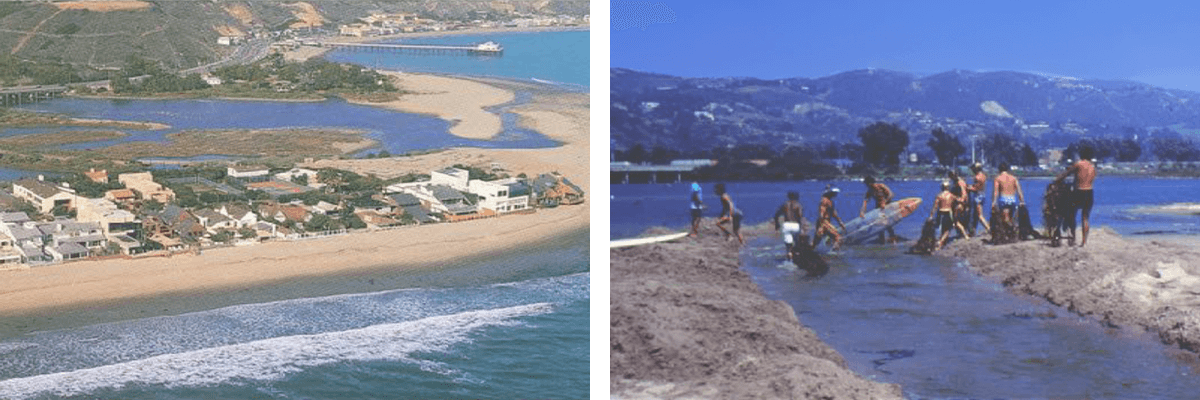
L: In 1983, construction of Malibu Lagoon State Park, and an artificial wetland, destroyed the natural interaction between the lagoon and ocean. R: Local surfers, led by such long-time Malibu veterans as Paul Minkoff, often tried to stop the outflow after the bulldozer left the beach, but State Parks policy continued to damage Malibu.
In 1984, after a stint of chasing waves and teaching in El Salvador, a young and motivated Glenn Hening was tinkering with grandiose ideas of establishing a surf club, modeled after the Cousteau Society and the National Geographic Society – a member-supported service organization that more genuinely reflected his interpretation of surf culture and values than what he was seeing in the neon day-glo surf magazines of the time.
Stars aligned and he was fortunate enough to be introduced to Lance Carson, a Malibu legend who was recognized as one of the best surfers in the world in the ‘60s. Carson was supportive of Hening’s idea and asked if it might be possible to do something right away about what was happening at Malibu.
“State Parks guys are destroying first point. I tried to stop them, but they just ignored me. They took down the 'Surfrider Beach' sign and changed the name of the place to Malibu Lagoon State Park. They carved up the lagoon, and when it starts to overflow, they bulldoze a channel straight toward the pier. The outflow gouges a channel across the bottom and the shape [of the wave] has been completely ruined, and these State Parks guys could care less."
Beyond being a cultural figurehead capable of rallying the surfing community, Lance Carson also introduced Glenn Hening to Tom Pratte, an expert on California’s Coastal Act. Pratte was able to leverage his official connections to schedule a public hearing where the community was able to voice their concerns to State Parks and Army Corps officials, and the nascent Surfrider Foundation made a strong case for an alternate plan, one that would protect the waves at Malibu and had overwhelming popular support.
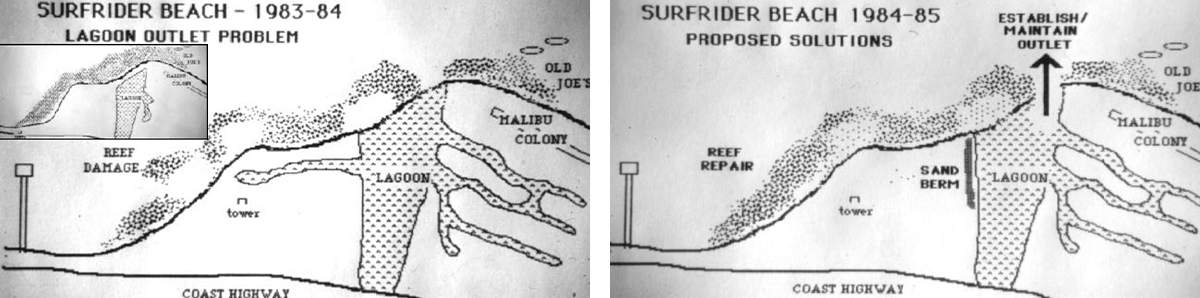
Early Macintosh graphics created by Glenn Hening and Tom Pratte made it possible for State Parks officials to plainly see the consequences of their decisions and for the Surfrider Foundation to outline an alternate plan to protect the shape of Malibu's perfect wave.
By the end of the public hearing, the enthusiastic crowd, led by Surfrider’s founders, had secured verbal commitments from State Parks officials that they would make every effort to meet the community’s demands.
Together, these three men — Hening, the visionary; Carson, the noseriding godfather of Malibu; and Pratte, the environmentalist — rallied their community and changed the course of surfing history to save a wave that remains a sacred part of surfing’s shared cultural heritage.
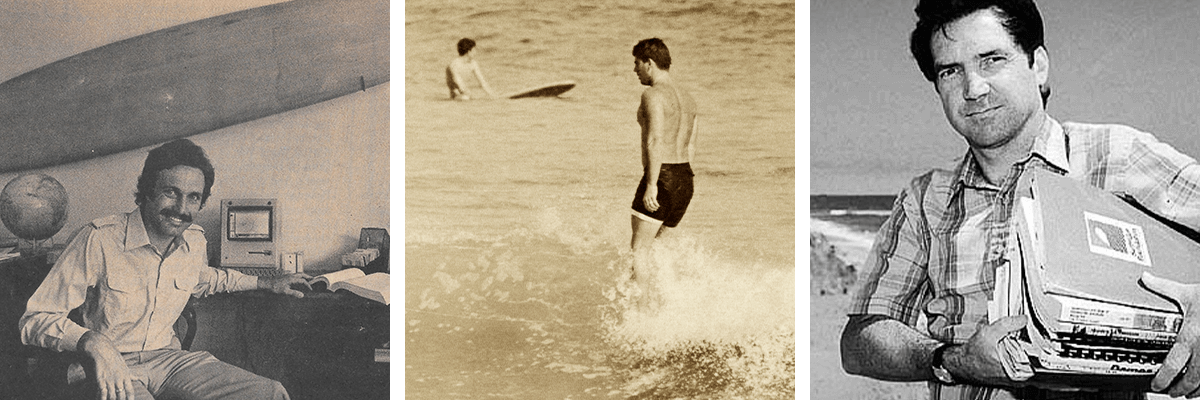 From L to R: Glenn Hening, Lance Carson, and Tom Pratte
"l have been blessed with 35 years of going to Malibu and enjoying the natural beauty of quality waves that break like a long string of falling dominoes. I have memories of clear water, lonely afternoons, Japanese clam diggers finding food at low tide, and things I may never see again. Progress is progress. and that's something that can't be changed. I've always known this, and I've always said, ‘Well, at least the waves will never change.' But now that may no longer be true.”
These are the opening words of Lance Caron’s speech, written by Glenn Hening, delivered at a public hearing at the Pt. Dume Elementary School auditorium on October 12, 1984, about the construction of Malibu Lagoon State Park, and its damaging effects on the natural surfing resource there.
40 years later, the Surfrider Foundation’s long-term success and growth are a tribute to its founders' vision that taking on an environmental battle may not be easy, but with constant pressure, endlessly applied, it can be won.
As we celebrate our 40th anniversary, Surfrider extends heartfelt gratitude to our founders and the early influential members of the organization, including Dan Young, Chris Blakely, Steve Merrill, David Moeller, Donna Oakley, Jericho Poppler, Alexa Bodrero, Penny Patrick, Rose Maverick, Marcia Davis, Mary Lou Drummy, and Surfrider's first ambassador, Shaun Tomson.
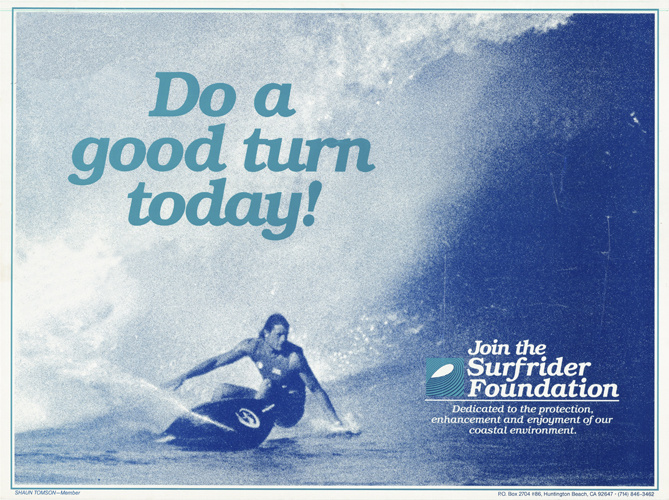
Surfrider's first professional athlete ambassador, Shaun Tomson, at Pipeline.
To dive deeper into Surfrider's history and milestones, visit www.surfrider.org/our-history
________________________________________
Glenn Hening remains an active entrepreneur and environmental philanthropist who went on to found the Groundswell Society in ‘95.
Lance Carson, despite having no interest in contests, was ranked #2 on a list of the world’s best noseriders by Surfer magazine in 1965. Featured in The Endless Summer, the filmmaker Bruce Brown famously remarked, “He’s so relaxed up there [on the nose of the surfboard] you get the feeling he could have a ham sandwich while he’s waiting around.” Carson learned to shape from Hap Jacobs in the late ‘60s and went on to found Lance Carson Surfboards in 1976, and is still hand-crafting a limited number of highly functional and collectible surfboards today.
Tom Pratte lost his battle with cancer in ‘94. Hening describes Pratte as “surfing’s first professional environmentalist” and credits him as the man most responsible for defining the Surfrider Foundation as surfing’s first grassroots environmental protection organization. Pratte went on to win official recognition for surfing as a recreational resource by the California Coastal Commission.
Header Image by Dylan Gordon