
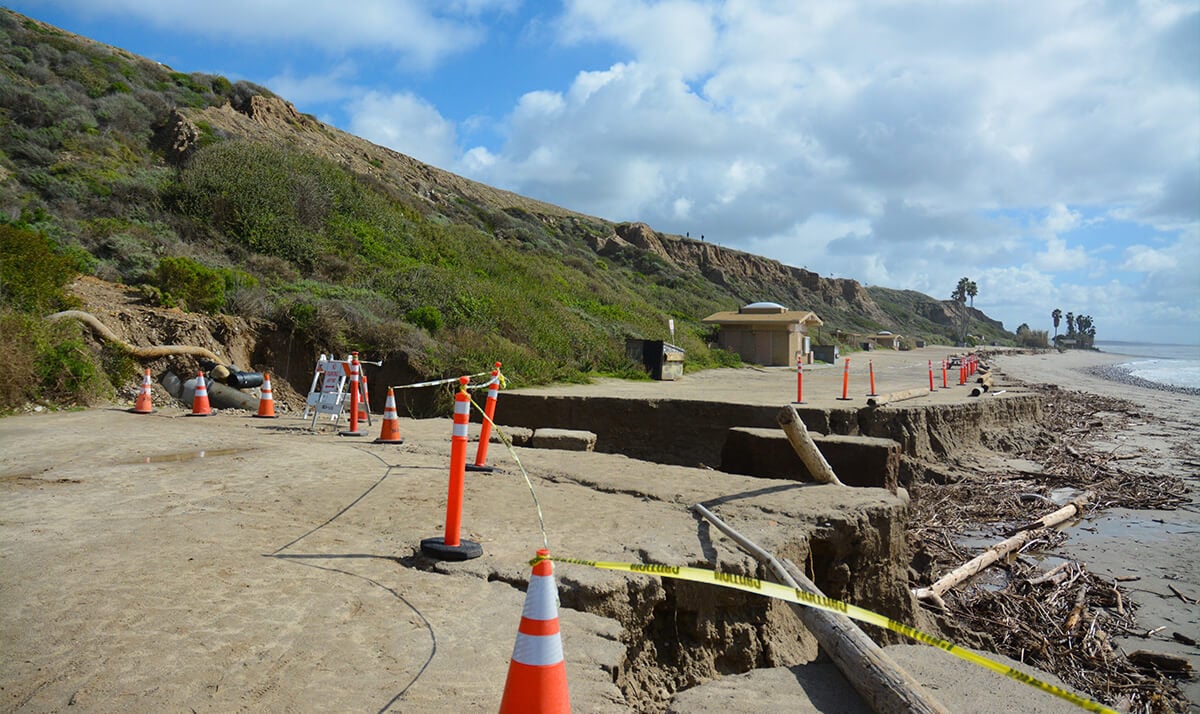
As the future of our coastlines hangs in the balance, the Surfrider Foundation is pleased to share the 2026 State of the Beach Report. Building on years of policy research and analysis on coastal management and sea level rise planning, this year’s report zooms in on one key aspect of coastal management that can undermine the best laid resilience plans: emergency shoreline armoring.

State of our Beaches: A State of Emergency
Beaches and coastal areas across the nation have been in a near constant state of emergency in 2026. Whether El Niño, numerous Pacific hurricanes, severe erosion, a September Nor’easter, a “Kelvin Wave,” or other extreme weather anomalies, 2026 has been a turning point for the impacts of climate change on our coasts. As these “emergencies” become more common along our shores, the state policy frameworks developed to allow emergency armoring to protect life and property in coastal areas, many decades old, are unintentionally contributing to the permanent loss of our beaches by enabling temporary emergency armoring to become permanent structures. Worse, in some states, temporary armoring simply becomes permanent due to a lack of enforcement that fails to remove temporary structures within a legally defined timeframe. This temporary-to-permanent permit pipeline is making our beaches more vulnerable to irreversible losses in the future.
Surfrider Foundation’s analysis found that 90% of coastal states earned a “C” or worse for their state laws and rules for emergency shoreline armoring.
Reactive Permitting versus Proactive Planning
At the heart of the problem with current emergency coastal armoring policy in most states is the tension between reactive permitting for acute hazards and proactive planning and adaptation for the future. While many states are moving toward long-term resilience planning and legislating programs and policy to that effect, they are being hamstrung by shortsighted emergency coastal armoring policy. The best-laid sea level rise and adaptation plans can be quickly undermined by an emergency shoreline armoring policy that incentivizes reactive responses, both during and after an emergency or hazard. Furthermore, as emergencies become more common along our beaches, it will become increasingly difficult to evolve from a hazard-by-hazard response to intentional, long-term coastal planning.
Modernizing Emergency Permitting To Protect the Future of Our Beaches
The 2026 State of the Beach Report serves as a call to action and how-to resource for states to reconsider both the intent and function of their policies around emergency shoreline armoring in this new era of climate change. In fact, this year’s report is being released as many states are currently revisiting existing policies, reflecting a growing shared understanding that every emergency shoreline armoring permit is a threat to the long-term future of our beaches and coastal areas. This year’s report also features several case studies from states where policy reform is underway to address permitting challenges.
As extreme weather is forecast to continue in many parts of the United States over the coming winter, one thing is abundantly clear: the state of our beaches doesn’t have to be a state of emergency.
Join Surfrider today and help us work to advance proactive coastal resilience planning in your community, so we can all enjoy the beaches of the future.
 As Senior Manager of the Coasts & Climate Initiative, Emma works with decision makers to implement policy solutions to protect coastal communities from the impacts of climate change. She earned her BA in history and political science from Warren Wilson College before launching a career in public service.