
.jpg)
Paco Lopez Mujica has been collaborating with Surfrider Foundation Rincón for over five years to conduct Blue Water Task Force water quality testing in the La Reserva Marina Arrecife de la Isla Verde located just west of San Juan on the north shore of Puerto Rico. This Reserve is teeming with life and Paco and his organization Arrecifes Pro Ciudad are working hard to educate their local community about the important biodiversity in the Reserve to protect it for generations to come.
Versión en español abajo.
Why and when did you get involved with the Surfrider Foundation?
For many years, Surfrider Foundation Rincón has been an inspiration for us in Puerto Rico as a non-government entity with a water-quality program among other environmental activities. In 2021, after Arrecifes Pro Ciudad got the Equipment Lending approval from EPA, we went to what we considered the best place to learn, Surfrider Rincón, with our friend Steve Tamar.
We learned about the sample collecting process, the laboratory procedures, materials, and equipment required. Apart from the technical aspects we learned from Surfrider, we got inspired to establish our water quality program in the Isla Verde Coral Reef Marine Reserve and continue inspiring new groups to start learning about the waters that surround our islands.
Tell us a bit about your organization, Arrecifes Pro Ciudad, and the work you do at La Reserva Marina Arrecife de la Isla Verde?
Arrecifes Pro Ciudad was founded in 2009 as an NGO that was dedicated to earning marine reserve designation. After following the route traced by Tres Palmas Marine Reserve in Rincón, in 2012 the Isla Verde Coral Reef Marine Reserve was designated by Law 274.
The Natural and Environmental Resources Department ordered the development of a management plan and installed perimeter buoys and educational signs — that’s the way we started. The Isla Verde coral reef is very near the shore and amazingly it holds a diversity of species like the Hawksbill, green sea turtles, manatees, and coral. It’s a nursery for fish that use this space to feed and grow before moving to deeper reefs.
Education is our main task — we have developed materials like coloring books, illustrated manuals, and informational signs to give the beach users and residents a real sense of ownership since this is a community-based initiative.
What are some issues that affect water quality in the Reserve?
This is the first urban marine reserve that we know of in the Caribbean. Being in the middle of San Juan metro coast, the reefs that protect the shores have been impacted for years with all kinds of threats, with bad water quality the biggest continuing problem.
It all started in 1950 with the International Airport construction and huge destruction of mangroves and sand extraction to construct the air strip and Boca de Cangrejos dredging.
Between the airport and the condominiums and hotels built on the beach with a poor sanitary and drainage system, locally the community has faced bad water quality issues.
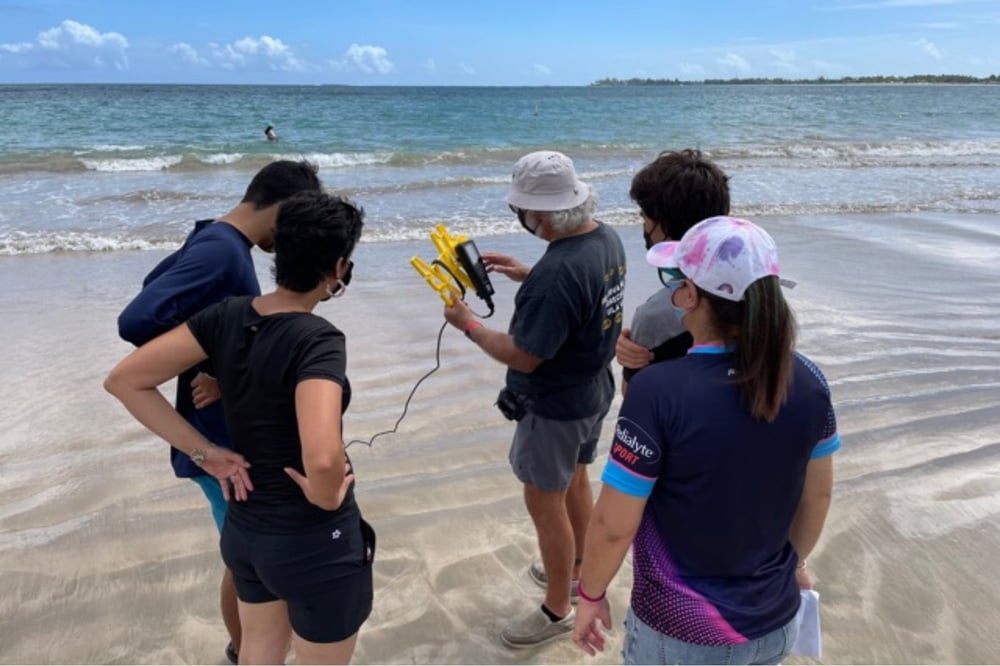 Lopez in the field with Rincón Chapter volunteers.
How is the Blue Water Task Force program helping to respond to those issues?
Since 2021 Surfrider Foundation Rincón and Arrecifes Pro Ciudad established a collaboration agreement — APC provides weekly data that is included in the BWTF National map (Puerto Rico). In exchange, APC receives materials to process the weekly samplings in five spots along the marine reserve shore.
We receive Enterolert and Colilert reagents, Quanti-Trays, pipettes, and Whirl-Paks for water sample collection and analysis.Thanks to this collaboration, we have been able to establish a constant water quality program to first understand how each point we collect behaves through time. Additionally, we identify the pollution sources and start a correction process. It’s a very difficult task, but at least we know what we are talking about, and approximately where the problems are.
Do you have any personal experiences where social justice and environmental movements have intersected in your community? If so, can you tell us about them?
When the marine reserve was designated, the municipality of Carolina was very interested in collaborating with the conservation effort. We signed an agreement between Municipio Carolina, Department of Natural Resources, and Arrecifes Pro Ciudad.
Although it was a perfect collaboration at first, APC left the agreement because we didn’t back the municipality in a hotel construction project in the east end of the marine reserve, a Leatherback sea turtle nesting site.
So the collaboration ended and we have been punished by the municipality during the last 10 years. It’s something that hurts the water-quality efforts since the municipality is in charge of the storm water drains that outflow into our coral reef. They don’t answer our letters nor any meeting requests. Absolute silence.
What do you find most rewarding about collaborating with the Surfrider Foundation?
A collaboration between NGOs is our best answer to what it’s happening right now with the federal government. The more we can accomplish together in the community and the less we depend on government help, the better we’ll be.
It is a great honor for APC to be able to learn from Surfrider, an organization that has been safeguarding our marine ecosystems for over four decades. Our responsibility is to continue doing the best we can and involving new groups and students following your example.
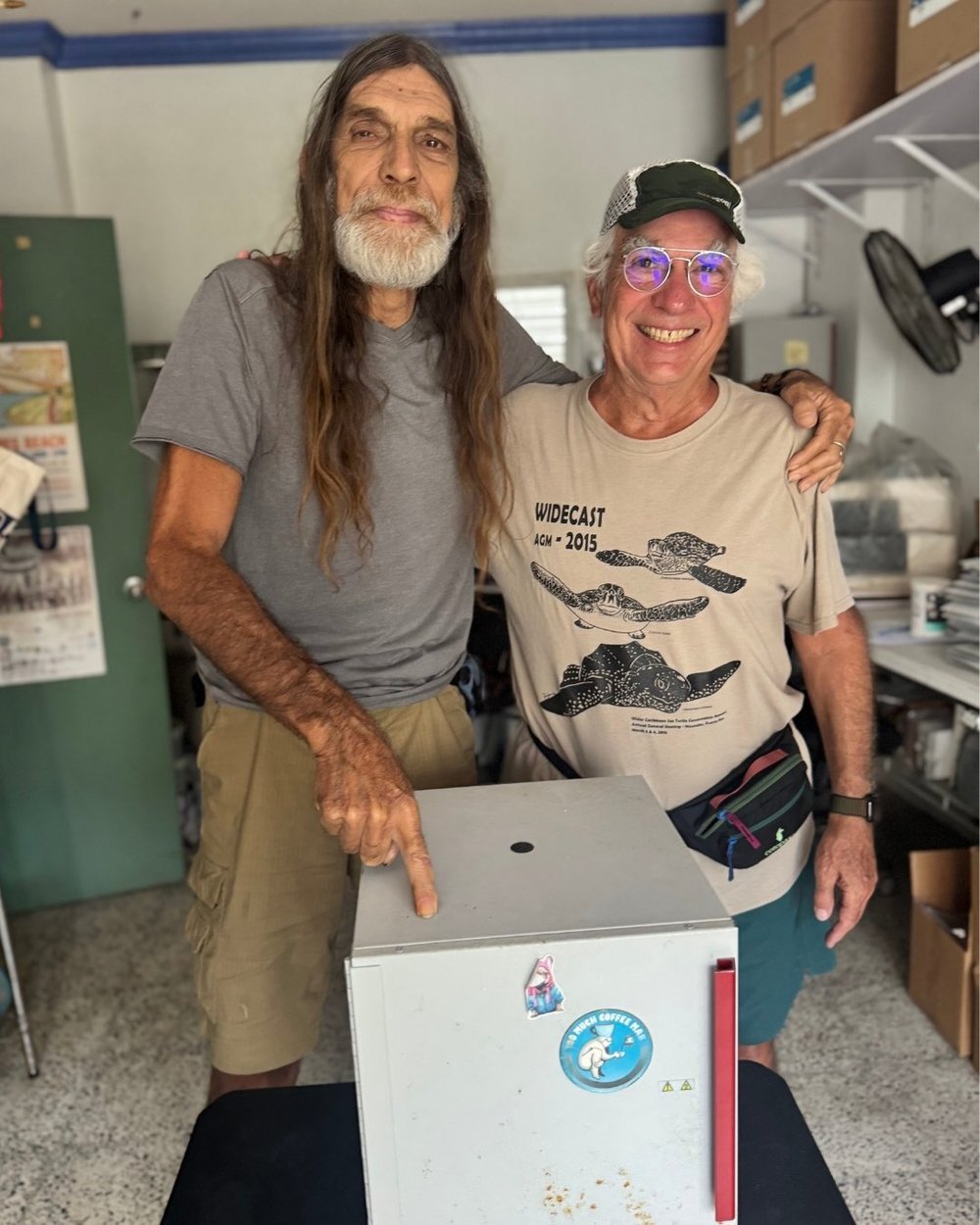 Rincón Chapter's Chair Steve Tamar (left) and Lopez (right) post in the BWTF lab.
Why is it important to you to protect our ocean, waves, and beaches?
The commonly used saying of “save the planet” should be changed to “Save human existence on the planet”. Very different. The planet will continue circling around the sun and its recuperation will be very fast without humans polluting the ocean. The corals will regenerate better than ever.
Another mistake we constantly repeat: “coastal erosion is a big problem” No, the problem is inappropriate and virtually unregulated construction on the beach front. In the meantime, here we are following our heart and conscience, doing what is right, and protecting our inherited place for the next generations to enjoy.
¿Por qué y cuándo te involucraste con la Fundación Surfrider?
La Fundación Surfrider en Rincón ha sido durante años una fuente de inspiración para nosotros en Puerto Rico como entidad no gubernamental con un programa de calidad del agua, entre otras actividades ambientales. Por eso, en 2021, tras obtener la aprobación de la EPA para el préstamo de equipos, fuimos a lo que consideramos el mejor lugar para aprender: Surfrider Rincón, junto a nuestro amigo Steve Tamar.
Allí nos capacitamos sobre el proceso de recolección de muestras, los procedimientos de laboratorio, los materiales y equipos necesarios. Además de los aspectos técnicos que aprendimos en Surfrider, nos inspiró a establecer nuestro programa de calidad del agua en la Reserva Marina Arrecife de la Isla Verde y a seguir inspirando a nuevos grupos a entender las aguas que rodean nuestras islas.
Cuéntanos un poco sobre tu organización Arrecifes Pro Ciudad y el trabajo que realizas en La Reserva Marina Arrecife de la Isla Verde. Arrecifes Pro Ciudad se fundó en el 2009 como una organización sin fines de lucro para gestionar los esfuerzos para la designación de una reserva marina.
Tras seguir el ejemplo de la Reserva Marina Tres Palmas en Rincón, en 2012 la Reserva Marina Arrecife de Coral Isla Verde fue designada por la Ley 274, que ordenó al Departamento de Recursos Naturales y Ambientales desarrollar un plan de manejo, instalar boyas perimetrales y señalización educativa, y así fue como comenzamos. El arrecife de la Isla Verde se encuentra muy cerca de la costa y, sorprendentemente, alberga una diversidad de especies como las tortugas carey y verde, manatíes y corales que aún sobreviven.
Además, es un criadero para peces que utilizan este espacio para alimentarse y crecer antes de trasladarse a arrecifes más profundos. La educación es nuestra principal tarea y hemos desarrollado materiales como libros para colorear, manuales ilustrados, animaciones y letreros informativos para que los usuarios de la playa y los residentes se sientan realmente involucrados, ya que se trata de una iniciativa comunitaria.
¿Cuáles son algunos de los problemas que afectan la calidad del agua en la Reserva?
Esta es la primera reserva marina urbana que conocemos en el Caribe y se encuentra en medio de la costa metropolitana de San Juan. Los arrecifes que protegen las costas se han visto afectados durante años por todo tipo de amenazas, siendo la mala calidad del agua el mayor problema.
Todo comenzó en 1950 con la construcción del Aeropuerto Internacional y la destrucción masiva de manglares, la extracción de arena para construir la pista del Aeropuerto Internacional y el dragado de Boca de Cangrejos. Esto, sumado a los condominios y hoteles construidos en la playa con un deficiente sistema de alcantarillado y drenaje pluvial, constituye una combinación perfecta para la mala calidad del agua.
¿Cómo está ayudando el programa Blue Water Task Force a dar respuesta a estos problemas?
Desde 2021, Surfrider Foundation Rincón y Arrecifes Pro Ciudad establecieron un acuerdo de colaboración. APC proporciona a Blue Water Task Force datos semanales sobre los resultados de las muestras para su inclusión en el mapa nacional de BWTF (Puerto Rico). A cambio, APC recibe materiales para procesar las muestras semanales tomadas en cinco puntos a lo largo de la costa de la reserva marina.
Recibimos reactivos Enterolerts y Colilerts, Quantitrays, pipetas y Whirlpaks para la toma de muestras. Gracias a esta colaboración, hemos podido establecer un programa constante de calidad del agua para, primero, comprender cómo se comporta cada punto de muestreo a lo largo del tiempo; segundo, identificar las fuentes de contaminación; y tercero, iniciar un proceso de corrección. Es una tarea muy difícil, pero al menos sabemos de qué estamos hablando.
¿Tienes alguna experiencia personal en la que los movimientos por la justicia social y el medio ambiente se hayan entrelazado en tu comunidad? Si es así, ¿podrías contárnosla?
Cuando se designó la reserva marina, el municipio de Carolina, donde nos ubicamos, mostró gran interés en colaborar con la conservación, por lo que firmamos un convenio entre el Municipio de Carolina, el Departamento de Recursos Naturales y Arrecifes Pro Ciudad. Fue una colaboración perfecta, pero pasaron dos años y se retiraron del convenio, ya que Arrecifes Pro Ciudad no respaldó al municipio en la construcción de un hotel en el extremo este de la reserva marina, un lugar donde anidan las tortugas Tinglar anualmente.
Así que la colaboración terminó y el municipio nos ha castigado durante los últimos diez años, lo cual perjudica los esfuerzos por mejorar la calidad del agua, ya que el municipio es responsable de las aguas pluviales que desembocan en nuestro arrecife de coral. No responden a nuestras cartas ni a ninguna solicitud de reunión. Silencio absoluto.
¿Qué es lo que más te satisface de colaborar con la Fundación Surfrider?
La colaboración entre Organizaciones No Gubernamentales es la mejor respuesta a la situación actual con el gobierno federal. Cuanto menos dependamos de la ayuda gubernamental, mejor nos irá.
Es un gran honor para nosotros, una ONG muy pequeña, poder aprender de ustedes, una Fundación que durante décadas ha protegido los ecosistemas marinos. Nuestra responsabilidad es seguir haciendo todo lo posible e involucrar a nuevos grupos y estudiantes siguiendo su ejemplo.
¿Por qué es importante para ti proteger nuestros océanos, olas y playas?
La frase tan usada de «Salvemos el planeta» debería cambiarse por «Salvemos la existencia humana en el planeta», muy diferente. El planeta seguirá girando alrededor del Sol y su recuperación será muy rápida sin los humanos contaminándola. Llos océanos, los corales y toda la naturaleza se regenerará mejor que nunca. Otro error que repetimos constantemente: «La erosión costera es un gran problema». No, el problema son las construcciones en la costa. Si no hay construcción la costa se va acomodando naturalmente. Mientras tanto, aquí estamos, siguiendo nuestro corazón y nuestra conciencia, haciendo lo correcto, protegiendo este lugar prestado para que las próximas generaciones lo disfruten.