
.jpg)
Located just south of Los Angeles, Orange County is characterized by dense residential development with pockets of commercial and industrial activity. Water scarcity and urban runoff are the two biggest water resource issues, yet perfectly manicured green lawns continue to be the default for residential yards and city parks. Traditional lawns consume copious amounts of water and contribute lawn chemicals like weed killers, pesticides, and fertilizers to polluted runoff.
To incentivize water conservation, local water municipalities offer lawn-to-garden rebates to help residents remove traditional water-guzzling turf lawns and replace them with water-conserving landscapes. When many of the lawn-to-garden rebates were developed in Southern California over a decade ago, the Surfrider Foundation advocated for these programs to align with our Ocean Friendly Gardens (OFG) program criteria. These rebates now require rainwater harvesting features, like swales or rain gardens, encourage the use of native plants, and do not allow plastic artificial turf.
While lawn-to-garden rebates have helped incentivize changes at the residential level, many public landscapes still reflect outdated practices. To meet the growing appetite for resilient public landscapes and the hands-on skills needed to maintain these biodiverse, living systems, the North Orange County Chapter (NOC) of the Surfrider Foundation hosts two workdays every month to steward two neighborhood parks. The chapter’s Ocean Friendly Gardens Coordinator, Paige Brue, brings valuable expertise from her background in stormwater engineering and years of leading OFG activities.
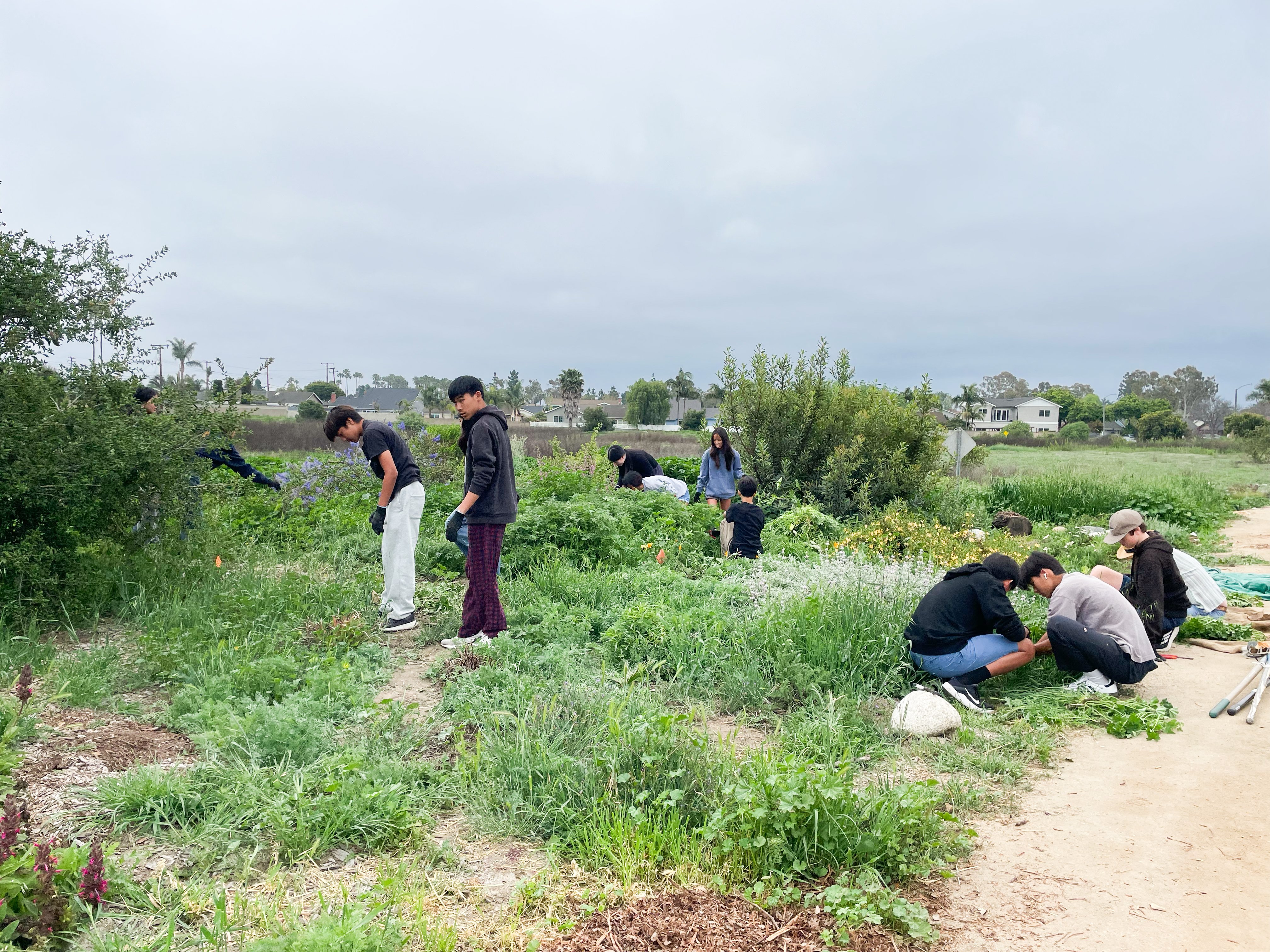
Garden workdays are well attended as the chapter advertises these events widely through social media and its newsletter. Garden activities vary seasonally. During hot, dry weather from late spring through summer, volunteers help remove invasive weeds, spread mulch, and tend to existing plants by watering, pruning, or collecting seeds. During cooler weather from fall through early spring, new plants are added, seeds are sown, and rainwater-retention features like swales and rain gardens are installed. In 2025, the NOC Chapter’s OFG events engaged 600 volunteers, planted 217 native plants and trees, and removed hundreds of pounds of invasive species!
But the impact doesn’t stop at the garden’s edge. Each volunteer who joins in and helps out builds a personal understanding of sustainable landscaping practices and skills that they can apply at home to make a positive impact in their own neighborhood. The NOC OFG program is also nurturing community leaders. At each of the parks the chapter helps maintain, a community member has stepped up to be a site captain to lead each workday. These core volunteers were not previously expert gardeners or landscapers, just community members who are passionate about protecting and improving their local green spaces.
.jpg?width=4284&height=5712&name=irbypark.seedcollecting.1%20(1).jpg)
At Irby Park in Huntington Beach, the site captain is Amanda Furches. Amanda is a member of a local tree society and was inspired by the natural ecosystem that had persisted for so long at the park, despite the minimal care and attention it received. Irby Park is an open field with a walking path that meanders around the perimeter, with several areas that flood and form a pond during winter rains. Among the tall weeds, many native salt meadow and wetland plants have persisted, and the park is full of wildlife, including hawks, owls, songbirds, and bumblebees. City crews used to tend the park once each summer by mowing down the weeds and pumping out any lingering water into the storm drains of the nearest street. Amanda first tackled improving the park by planting more native plants and trees. When she connected with Surfrider and began co-hosting monthly workdays at Irby Park, the chapter was able to support her efforts by recruiting more volunteers and supplying plants and tools. Irby Park now has several bioswales, deeply rooted trees, and many species of native plants blooming throughout the year. Stormwater is no longer being treated as a problem to be disposed of, but rather as a valuable resource, with rain directed towards swales and native vegetation to soak into the ground.
.jpg?width=2338&height=4076&name=riversend-paige%20(1).jpg)
.jpeg?width=4000&height=5282&name=riversend.mcoats.2%20(1).jpeg)
River’s End Park in Seal Beach is the other public park the NOC Chapter’s OFG program is actively stewarding. This park is adjacent to the outlet of the San Gabriel River and was created as mitigation for the development of a nearby residential area. River’s End Park is maintained by the City of Seal Beach and features walking trails with great ocean views, as well as a stormwater retention basin that captures polluted runoff from adjacent houses and streets. Unfortunately, River’s End Park also had many weeds and bald spots between areas of native plants.
A neighbor who enjoys bird watching, Rheo McColl, became concerned about the state of the park. Rheo started pulling weeds and contacted the city to fix the broken irrigation. She also received permission to add more diverse native plants to the park. Once Rheo connected with the North OC Chapter to host workdays, she had ample help from Surfrider volunteers to add native plants that provide food and habitat for birds, pollinators, and other local wildlife. The deep roots of these native plants also support healthy, living soil to soak up rain and runoff. Volunteers are still working to remove the more pervasive weeds and establish greater plant cover in the stormwater basin to improve infiltration. The workdays at River’s End have been a proactive way for the chapter to support water quality upstream and enhance resilient wildlife habitat.
The consistent stewardship activities at River’s End Park have also sparked conversations about the nearby sand dunes. These remnant dunes lack clearly defined pathways or symbolic fencing to restrict motor vehicles, so they are routinely trampled by e-bikes and foot traffic. The core volunteers who are restoring native plants at River’s End Park are now working with the city to get the permits needed to protect the dunes and restore dune habitat. Through OFG activities, the chapter has built trust and rapport with the City of Seal Beach and is excited to see how this partnership develops to support interconnected, resilient habitats and neighborhoods along this unique coastal area.
The model of site captains working in tandem with the chapter’s program coordinator has significantly increased the scale and capacity of the North Orange County Chapter’s OFG program. Through these consistent hands-on community workdays, the chapter is protecting clean water and engaging its community in stewarding nature-based solutions that support healthy, resilient watersheds.
 As Ocean Friendly Gardens Manager, Kathryn is passionate about advocating for watershed protection through gardens and landscapes. She graduated from UC Santa Cruz with a B.S. in Marine Biology, and developed a love for California native plants and restoration work during her time at the Los Cerritos Wetlands in Long Beach.