
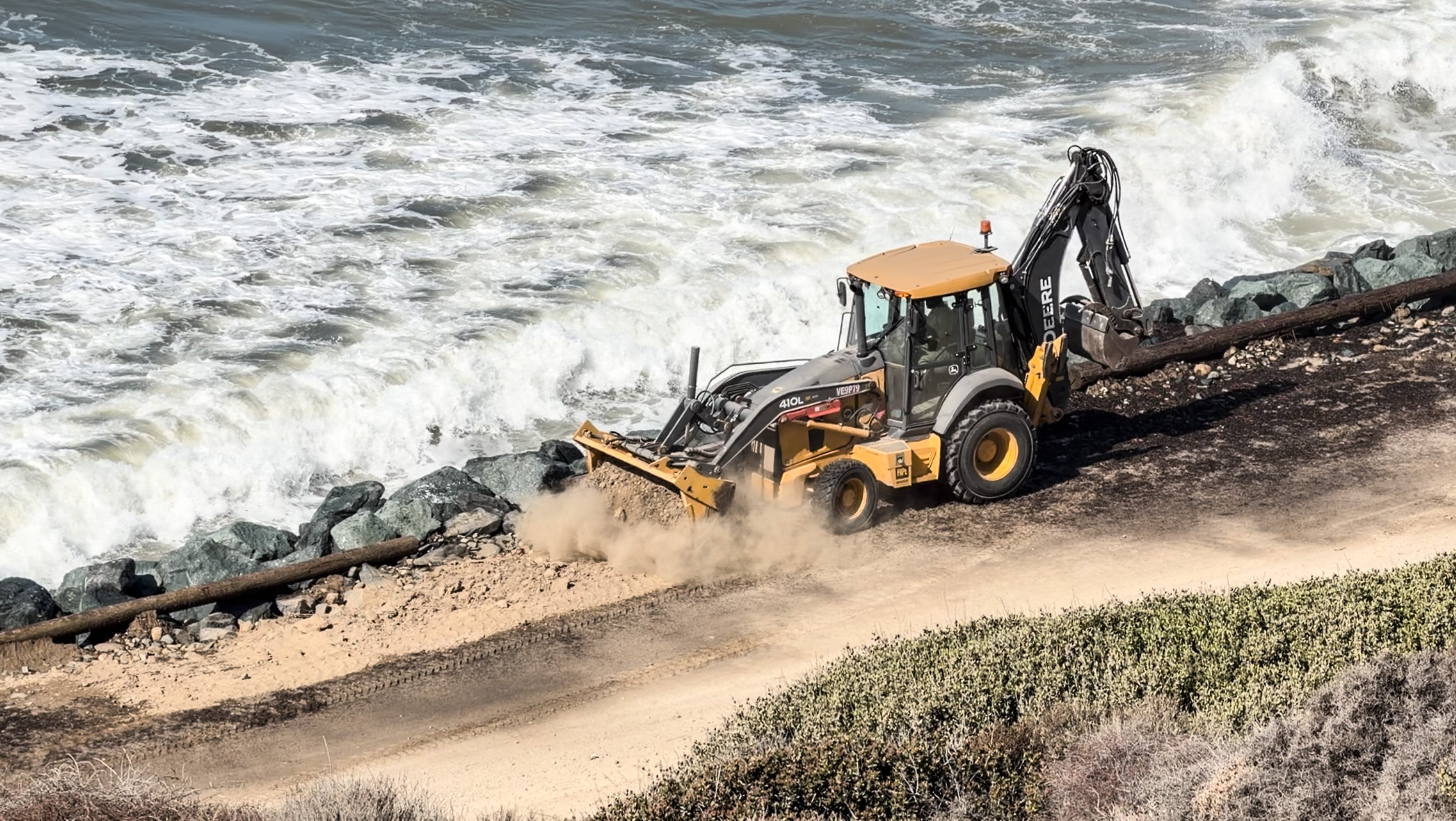
Urgent update on access at San Onofre State Beach:
Beach parking at San Onofre State Beach has been closed after the Hurricane Rachel swell and elevated tide* caused significant shoreline impacts on 10/7. More coastal impacts at San O are likely to come as we enter a historic El Niño season.
*As a result of El Niño and extreme marine heat, tide levels have been consistently measured 6-12 inches higher than tide forecasting.
Surfrider and our partners at San O (California State Parks, the Juaneño Band of Mission Indians Acjachamen Nation, San Onofre Parks Foundation, and the San Onofre Surf Club) have been planning for this situation. Still, we did not expect it to arrive so early.
That said, we are optimistic. Proactive planning, coalition building, and an uncompromising passion to protect our coasts have put San O in a best-case position to respond to this year’s challenging conditions.
Thank you to everyone who loves and stewards this beach.
Quick Read FAQ
Q: When will beach parking reopen?
A: We’re not certain when beach parking will reopen, and without a significant intervention, it may not. State Parks was already implementing intermittent closures during high-tide events to ensure vehicles were not stranded should significant erosion occur, and now, with the road much narrower, there is concern about the stability of the road. We fully support ensuring the safety of all visitors to San O, and are working to co-develop a parking option that fufills the needs of as many users as possible within the current constraints.
Q: How can I get to the beach in the meantime?
A: Visitors are still allowed to head down to the beach, provided they can get there without a vehicle. Some folks are parking at Trails and riding bikes over; however, we understand this does not provide access for everyone.
Q: Who decides what happens next at Surf Beach?
A: In part, the State, and in part, the federal government. CA State Parks manages this land, but only with the permissions afforded by the USMC. Both parties are highly invested in the integrity of Surf Beach, and ultimately what happens at Surf Beach will be guided by what’s possible. No one wants access cut off — if you think visitors don’t want a closure, imagine being the body in charge of the fifth most visited state beach!
Q: Why not just build a bigger seawall?
A: While the rip rap revetment (seawall) installed as a response to the 2016 El Niño narrowing the access road, it has both protected vehicle access and destroyed large sections of the beach in front of and adjacent to it. There is not much appetite for further degradation of the beach with hard armoring, especially with a long-term nature-based resilience project underway.
Q: Why not just build a jetty? Or five?
A: Jetty’s can look appealing with their sand-trapping skills, but they will impact the surf zone, massively disrupt important sediment transportation, and disrupt the coastal dynamics we’re looking to restore in order to provide further resilience. And while they may filter some steeper waves, they won’t stop swell-born erosion.
Q: What is a Nature-Based Solution?
A: Learn more at surfrider.org/fighting-climate-change-with-nature
Q: How can I help?
A: Stay informed! Scroll to the bottom to add your name to the San O email list for updates and ways to add your voice and impact.
Immediate Solutions
What can be done right now
Since 2025, Surfrider and our partners have been asking the San O community a hard question: if the lower lot closes, which of the limited options would work best for you?
You showed up, and we heard you. Across our community assemblies and this summer's virtual survey, you, members of the San O community, told us how you weigh those trade-offs. More than two-thirds of respondents said they would be willing to park elsewhere (off the beachfront) at times if it meant more consistent access to the beach. You also weighed in on overflow parking on the bluff, trail and staircase options down to the sand, and what access needs to look like for adaptive surfers and, importantly, visitors with mobility disabilities.
That input matters now more than ever. We have a clear picture of what the community wants, and we have solid ideas for how to deliver it, sooner rather than later. We are bringing those alternatives and the feedback received to California State Parks and our partners as the situation develops to craft an access alternative while regular beachfront parking is inaccessible.
The local community feels the impacts firsthand, waiting tenuously with high tides flooding and closing the parking lot; and now, we watched helplessly last week as the vulnerability escalated to the Park’s closure of the road. At the same time, the revetment experienced flanking erosion, causing further erosion and narrowing of the road. On the inland side, stormwater, intensified by torrential rain, swiftly carved an impassable trench across the road within the span of just a week.
These compounding forces highlight the delicate nature of accessing the beach at San O and the urgent need for resilient solutions to protect both access and the natural resources of the State Beach.
State Parks staff working to repair and remove damaged infrastructure the next morning.
The Short Term
What can be done this winter
Alongside access planning, our team has been working to develop a pilot project that could be placed on the beach almost immediately: a scaled-down cobble berm at the end of the revetment, where Surf Beach is most vulnerable. Cobble berms are made of rounded rock, like what is already found under the sand and making up the reef at San O. Cobbles shift with storms and absorb wave energy, allowing that energy to run up and dissipate instead of reflecting it and scouring the beach. They also give sand a foundational slope to build on over the summer months. A cobble berm is both the community's top pick and the most technically feasible alternative.
The pilot is pending approval from the agencies that oversee the beach, and if approved, will then need access to quick funding.
Unfortunately, funding and permitting for dynamic, nature-based solutions are harder to achieve than for traditional armoring. But we know more walls would only harm the beach further, and the construction of those walls and the damage left is incredibly difficult to restore once it’s done.
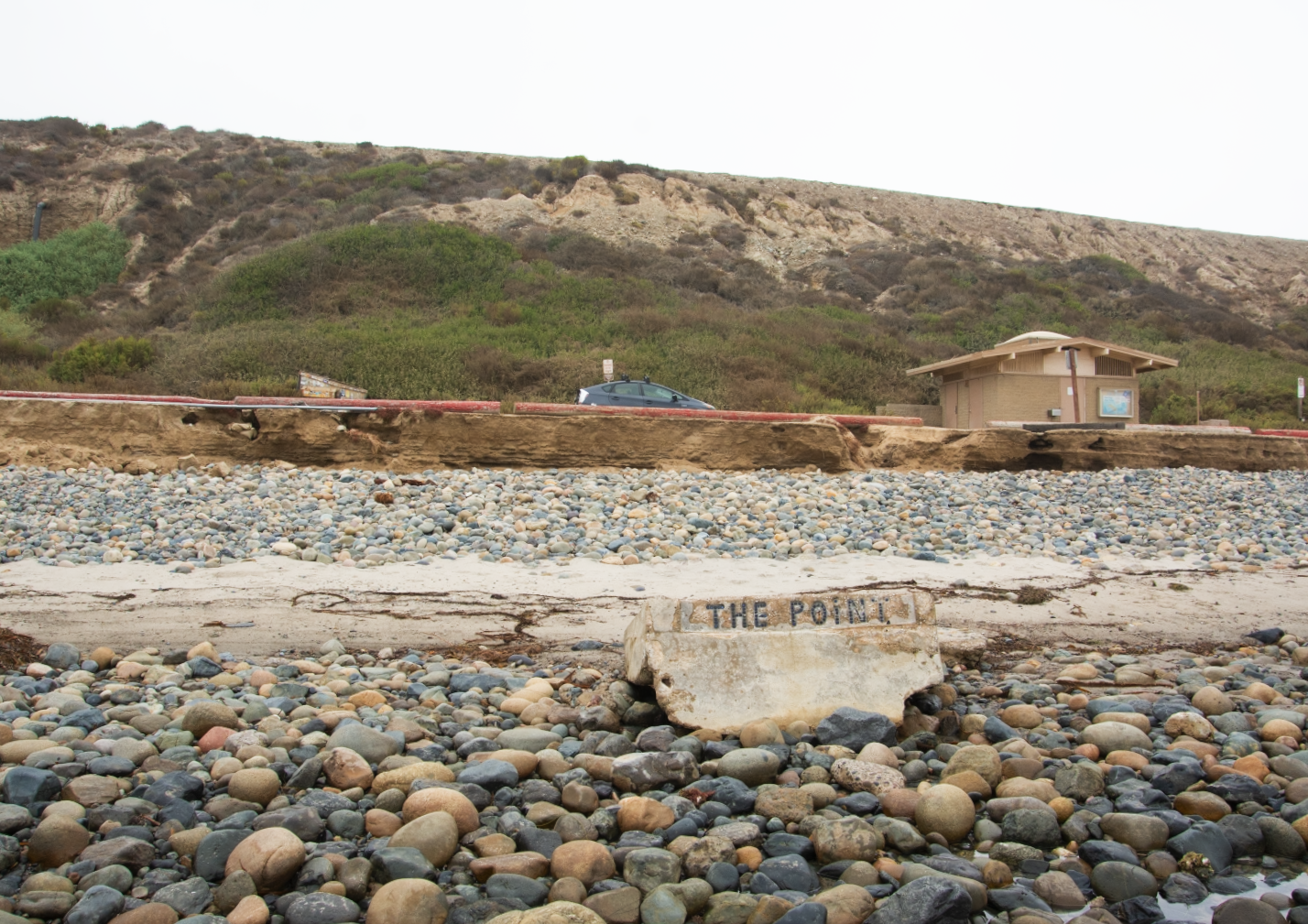 Cobble rich San O
In addition to adding protective cobble, California State Parks is taking immediate action to remove restroom #2. Removing it creates more space landward and eliminates the risk of a critical failure sending hazardous material (yes, poop) into the ocean at San O.
Surfrider, the San Onofre Parks Foundation, the San Onofre Surfing Club, and the Juaneño Band of Mission Indians Acjachemen Nation have been working to make this happen, including seeking in-kind support through the Surfing Club to carry it out. Under emergency conditions, State Parks can now draw on funds to act, and we are grateful.
Restroom #2 being removed, images courtosy of CA State Parks
The Long-Term Plan Keeps Moving
None of the recent developments will impact the progress on the San Onofre Shoreline Resilience Project!
While San O weathers an early start to the winter season, Environmental Science Associates (ESA), the engineering team behind Surfers' Point in Ventura, is finalizing its recommended alternative. We will bring it back to you, the San O community, on November 6. (Save the date; details coming soon!)
We have listened to your hopes for this project, and understand some frustration that it is taking time. We hear you. And we know how important this place is to all of you, which is why it is important to Surfrider and our partners for us to take the time to get this right, rather than to simply move fast and break things.
One year to study the beach, complete geotechnical and hydrologic work, model conditions, and develop alternatives is incredibly ambitious. For perspective, Surfers' Point took 30 years to complete.
Rest assured, we're moving as quickly as we can at San O.
How to Stay Updated
Surfrider is in close contact with California State Parks and our partners, and we will share updates at the top of this page as the situation develops. Everyone involved is working incredibly hard on our shared goal to save access at San O.
To stay informed and receive updates on the state of the beach at San Onofre and our efforts there, sign up below.
%20-%20600%20x%20600%20px-Aug-04-2026-10-14-09-8931-PM.jpg) As Surfrider's Coastal Preservation Manager, Alex (she/her) focuses on coastal resiliency projects centered around nature-based solutions. She has worked on the ocean as a naturalist and passionately seeks to connect new folks with the sea by linking core memories on the water with education about the impact of marine preservation.
As Surfrider's Coastal Preservation Manager, Alex (she/her) focuses on coastal resiliency projects centered around nature-based solutions. She has worked on the ocean as a naturalist and passionately seeks to connect new folks with the sea by linking core memories on the water with education about the impact of marine preservation.