
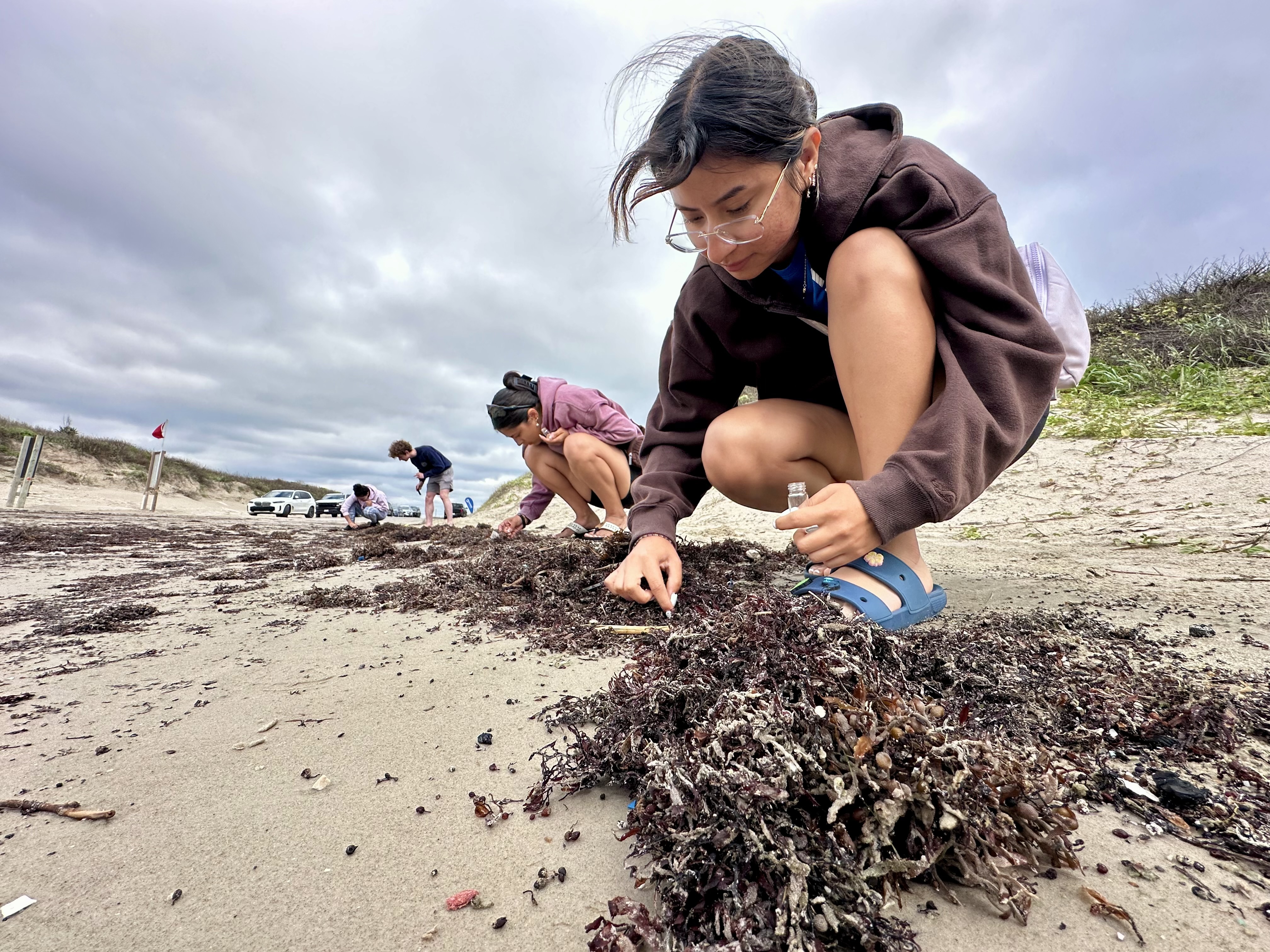
Last month, the second annual International Plastic Pellet Count took place across the country. Surfrider chapters and student clubs teamed up with partner organizations to host pellet counts from New York to Ohio, South Carolina to Texas, and Orange County to San Diego! Volunteers stepped out into their local environments to document plastic pellet pollution firsthand. While each location tells its own story, together they reveal something much larger: a widespread and persistent issue that spans coastlines, waterways, and inland communities alike. This collective effort not only strengthened the dataset, but also underscored the impact of grassroots action in building a clearer national picture of nurdle pollution and the urgency of addressing it.
The Day of Action: California and Texas
The “day of action” that was encouraged was Saturday, May 2. Four Surfrider chapters and one Surfrider student club participated on this day!
In San Diego, volunteers teamed up with partners at California Public Interest Research Group (CALPIRG), Oceana, and San Diego Coastkeeper. Their 10-minute cleanup of just 12 volunteers produced 697 nurdles, and their effort was picked up by NBC News!


Further up the coast, we also saw a pellet count by the North Orange County Chapter, teaming up with CALPIRG again, on the first Saturday in May! 4,138 nurdles were found on Seal Beach within a two-hour window. This was accomplished by only 21 volunteers in a very small area. It’s amazing to see that small crews of volunteers can collect such high numbers of nurdles in a short amount of time.


Meanwhile, in Texas, there were a few pellet counts going on. The Texas Coastal Bend Chapter worked with the founder of Nurdle Patrol, Jace Tunnell, a researcher who started the website and mobile app to document the problem of pellet pollution. Even though their beach in Corpus Christi was flooded, the pellet count was on, and 12 people found another 337 pellets in just a twenty-minute patrol.
Also in Texas, the Galveston Chapter worked with a Surfrider student club from Ball High School. This dynamic duo has been working together to host cleanups on Galveston Island, drawing more people to their events. They decided to add the ten-minute pellet count into a cleanup they were already planning for May 2. While their search only turned up one nurdle – which is a good thing – it’s still important to log the data, even if the number is zero.



The Pellet Counts Continue...
This year, the International Plastic Pellet Count was not limited to a single day. Any pellet count that occurred during the month of May would be counted towards the overall effort. So, we still saw some pellet counts happening over the next few weeks!
-
Eastern Long Island Chapter: 4 people, 108 pellets
-
Amherst Steele Student Club: 4 people, 31 pellets
-
Grand Strand Chapter: 27 people, 2 hours, 79 pellets


There were two additional pellet counts planned by the Bogue Banks and Charleston chapters but unfortunately were cancelled due to inclement weather. Hopefully it works out for the next International Plastic Pellet Count!
In total, Surfrider Foundation volunteers and student club members helped to collect 5,391 plastic pellets with our partners!
The Count is Over…Now What Do We Do?
While the second annual International Plastic Pellet Count has come to a close, there’s still more that can be done on pellet pollution.
-
Host a pellet count anytime. Pellet counts don't just happen in May. You can help document the problem of pellet pollution by gathering pellets and data and upload your findings to NurdlePatrol.org. They also have a mobile app!
-
Support legislation. The Plastic Pellet Free Waters Act would set a no discharge limit for facilities that make or transport nurdles. Learn more here.
-
Share about plastic pellets with others! Send this blog to a family member or friend to educate about the problem of pellet pollution! Or, check out the Annual International Plastic Pellet Report, just released this week.
By continuing to document plastic pellet pollution, advocate for stronger safeguards, and engage their communities, volunteers are helping create a future with cleaner waterways and healthier ecosystems.

 As Senior Plastic Pollution Initiative Coordinator, Jenna supports the Beach Cleanup and Ocean Friendly programs. She graduated from Stony Brook University with a B.S. in Marine Vertebrate Biology and an M.A. in Marine Conservation and Policy.